Home Index The Wives of King Canute The Clockmender Daughter of the Sea The Girl in the Great House Singing for Mr Bear More Poems Ransom Books About Maggie Press Release Events and Interviews
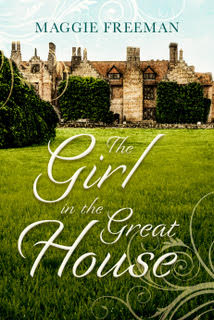
The Girl in the Great House extract
Elaine was climbing the track to Cymberie.
The leaves of the oaks swayed above her head and sang; the mossy bank
was velvet beneath the soles of her feet. A cock crowed some way away.
She could just hear the voices of the men in the harvest field, the
swish of their sickles through the stalks of ripe wheat.
She was
sweating slightly. A horsefly settled on her cheek and she slapped at
it. She felt scared on her own, incomplete, as if there were only half
of her here. Will Samuel be safe with Mistress Margery? she worried.
He’d almost leapt from her arms into the hedged garden of hollyhocks and
pink crawling babies, he’d settled by a cabbage sucking a stone. Margery
had said: Don’t concern yourself about him. I’m used to caring for
infants. Trust me.
I’ve no choice, Elaine thought. I have to have
money. But this – this thing I’ve said I’ll do today – I can’t bear to
do it.
The moss came to an end and she stepped down on the track. The
earth was warm, the pebbles hard but they didn’t bother her; she’d
walked barefoot for months, ever since March. She skirted round the
horseshit. What will Cymberie be like? she wondered. She had never been
to the house before. She’d heard tell of it in the village, how huge it
was, with its many windows paned with glass and white swans floating on
the lily lake. A tall fountain showered silver water, people said, and
the kitchen overflowed with food: roast venison and quail, gingerbread
and marchpane. It was two days since she had eaten even plain stale
bread.
If only it were not him, she thought, if only it were some
other man. I could bear to do this for any other man. I could manage it.
I wouldn’t mind. But him…
She stretched out her arm, looked at how
thin her wrist had become, saw that the skin had sunk into the fan of
bones in her hand. That it was almost translucent. She had to have food.
She wouldn’t have cared for herself, wouldn’t have minded if she lived
or died, but Samuel – he changed the matter.
In the palm of her left
hand was the scar of the cut she’d got when her husband Thomas’s chisel
had slipped. She’d been working on a carving of Cupid and he had leant
across to neaten a feather on the young god’s wing. She had turned to
kiss him; his attention wavered. It was her fault, truly, not his. The
cut had healed well. It was the last relic of his love left on her body,
and she kissed it.
At the top of the hill the woodland came to
an end. The great oak at the edge spread its branches over the level
scythed grass; Elaine stayed in its shade. Solid in front of her stood
Cymberie, a block of dull brick beneath a steep slate roof. Octagonal
chimneys twisted into the sky. Smoke rose from one of them, blue smoke
that drifted toward her. Apple wood: she recognised the sweet smell
instantly, and grieved for the tree that had been felled for fuel when
it might have grown on to provide food. Crisp apples, red-skinned,
yellow-fleshed, running with juice; her mouth ached with longing for the
taste. All she’d had to break her fast this morning were a few currants
she had snatched from bushes at the side of the road. Her belly rumbled
and she hoped it wouldn’t when she was with him, when his head lay close
against her chest.
I can’t do it, I can’t do it, she had said to
Mistress Margery in desperation this morning, as if it were something
that could be avoided. I don’t know how to do it.
Nothing could be
simpler, said Margery, who had arranged it all, who was going to take a
half share of her payment in return for looking after Samuel. Anyone can
do it. It’s instinctive.
Elaine stepped out into the July sun and
half-closed her eyes against its dazzling brightness. The heat burned
through her bodice, into the linen shift next to her skin. The scent of
lavender gusted toward her from bushes that rocked in the breeze like
grey waves of the sea. Bees hovered over them, sucked nectar from the
flowers. The garden hummed. White butterflies flapped. Up in the blue
sky larks sang their high song.
This is a voyage I am setting out on,
she thought. Exploration of an unknown land. I’m afraid of what I may
find.
The leaded casements of an upstairs room were latched open. But
no-one was around. No gardener was trimming the low box hedges, or
carrying water to the fountain that was parched dry. The marble statue
in the empty pond glared in the sun.
I wish I were made of marble,
she thought; if I were made of stone, if I didn’t have feelings, this
would be easy. How easy to be a statue here in the sun where no-one is
weeding the borders or sweeping the gravelled alleys, no-one is anywhere
at all.
The house seemed uninhabited, unreal, a mirage in the heat.
But its main door beckoned her on, its massive oak door with arched
moulding, set in a square frame. A huge keyhole that when she bent to
it, she found was blocked, so she couldn’t see through. She tried the
latch but the door didn’t budge; it must have been locked, or bolted on
the inside. There was a great bell but she didn’t ring it. This isn’t
the right door for me, she thought, this entrance is for the fine folk,
there will be a small door somewhere for people like me. She released
the latch as quietly as she could and followed the path under the gloomy
hollies at the side of the house until she came to a cobbled yard, where
there were stables: the stink of horses. Black hens pecked between the
stones. Straw; tufts of grass, dog shit. A ginger cat snoozed on a
ledge. Housemartins swooped low on purple wings down from their mud
nests under the eaves, almost colliding with her.
The house walls
here were of stone, and clearly older than the brickwork at the front.
The windows were arched rather than rectangular. A plain door stood wide
open at the top of two steps.
Elaine peered in. A long passage paved
with stone and deep in shadow lay before her like a lime-washed cave.
She hesitated; combed her hair with her fingers and coiled it up neatly,
shook her skirt, pulled her sleeves down to her wrists, squared her
shoulders. ‘Good morrow,’ she called out.
There was no answer. She
entered, stood still a few seconds for her eyes to get used to the lack
of light. The flagstones were cooler under her feet than the stones
outdoors. A fustiness hung in the air, a smell of damp though it had not
rained in days. Muddy clogs of various sizes were spread out in pairs on
a low rack; a few sacks, a worn bridle and an axe hung from hooks on the
wall.
‘Good morrow?’
No reply. She stepped past several closed
doors. Her feet made no sound. The whisper of her linen skirt seemed
like thunder in the silence; she held it up to try to make it quiet.
Birdsong seeped in from outside.
The door at the end of the corridor
was ajar, letting in a sliver of light. She knocked on it but there was
still no response. Again she called out, ‘Good morrow,’ then gently
pushed the door open and stepped through.
She was in the kitchen. It
was empty of people but full of the fragrance of food. Flour spotted the
stone floor. Soot-black pans stood on the unlit grills below the window;
baskets of onions and feather-flecked eggs slouched beside them. The
oven door hung open. A kettle simmered by the fire, which was very low,
almost all ash. Someone will have to relight it if it goes out, Elaine
thought, I will save them the effort; and she placed two fresh logs on
it from the stack at the side. A little thud; a puff of grey punctured
with sparks. It’s so quiet here, she thought. All the servants must be
down in the harvest fields, they will be cutting the wheat. Raking it
into stooks, to dry while the fine weather lasts.
The top of the
scrubbed oak table was covered with a white muslin cloth weighed down at
the edges with scarlet beads and swarming with those little black
beetles she didn’t know the name of, that when they sat on your bare arm
nipped through the skin and brought a bubble of your red blood to the
surface; also with iridescent green flies. She lifted a corner of the
cloth and saw pies and bread – huge meat pies glossy with egg glaze and
ornamented with leaf and corn-sheaf shapes, beef gravy oozing brown
under the lids, blackcurrant pies where the pastry was stained purple,
and great loaves marked with crosses on the top, sprinkled with caraway
seeds – they were cooling on racks – and pasties with thick crimped
edges where the pastry swelled with chunks of lamb, turnip and onion.
There was a vast round cheese there, with just a wedge out of it: how
she longed to cut a slice with the knife at her side. She couldn’t help
but imagine the cheese crumbling in her mouth, its salt filling taste.
But all this belonged to Sir Richard Belvoir. She couldn’t touch it. Not
when he had done that to Thomas. She lowered the cloth. Her mouth was
dry; she longed for a drink. She looked at the beer-barrel, touched her
mouth with the side of her finger, licked her lips. But she turned away,
lifted the latch on the inside door of the kitchen, and stepped through.
© Maggie Freeman 2012